
Study on children's use of technology
As part of the regular curriculum of Shkolla Digjitale, where in the form of a course for children under 18, programming, computer science, robotics and electronics are taught, the lessons of…
As part of the regular curriculum of Shkolla Digjitale, where in the form of a course for children under 18, programming, computer science, robotics and electronics are taught, general lessons about technology and digital education are in special focus at all times.
Considering the level of exposure to technology in a child's life, it is very important to understand whether we are preparing children in the best way for them to face a life so dependent on technology.
To understand more in this direction, Shkolla Digjitale has started to analyze children's habits in relation to technology. From the first results where more than 500 children aged 7-15 were surveyed with 12 basic questions, we have these results and analyses.
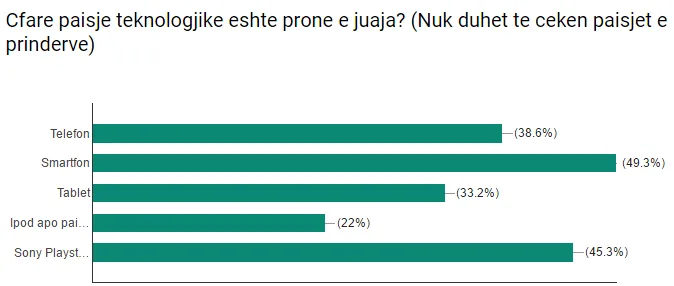
Most children have more than one device in their possession. It is important to note that 45% of children have Sony Playstation, Xbox or Nintendo, not overlooking the fact that 50% only have a personal smartphone.
The topic of smartphone addiction is not something discussed only in relation to the child, but it also applies greatly to adults. More than 43% of children admit that they are addicted to their phone.
When children were asked about their online activities, over 73% stated that they visit Social Media like Facebook and Youtube. In the case of Facebook, it is important to note that the allowed age is a minimum of 13 years. This rule is greatly overlooked by children.
It is strange to think today of going without technology for 1 month. During the summer school organized by Shkolla Digjitale Summer School and Camp, children besides lessons, had the chance to spend two days at the Germia camp in Prishtina where the most frequent question you could hear from children was is there Wi-Fi here! Normal, from those who didn't have 3G or 4G.
Social networks have become part of children's lives, whether we want to accept it or not. If those children who are not part of social networks today, the chances are very high that they will soon become part of them, given the high social pressure they face from society. Most children use social networks at least once a day or more.
A question perhaps a bit difficult for children, however 71% stated that they understand it.
However, all these children who answered that they understand, when asked for details about what things they understand, could not answer even basic things about the issue.
The problem is that if you ask this question to adults, you will also understand that most social network users are not able to understand the terms of use.
In the case of children, it is important to note that today they are facing a high online social pressure, a pressure that previous generations have not experienced. It is important to analyze and understand this issue, as it can also lead to psychological consequences for children from various harassments or from the display of inappropriate content, without going further into other topics such as identity theft, scams, severe harassment, viruses, etc.
Most children use social networks more for other purposes such as playing games or wasting time. On the other hand, where the basic purpose of social networks is to connect with people or groups of common interest, less than 20% of children use them for this reason.
When we ask children what Digital Citizenship is, we can see that almost half of them do not know that being a digital citizen is the same as being a citizen when you go out on the street, and civic education is fundamental for each of us. By the very fact that we are spending a good part of our lives in front of our screens, just because we are hiding behind a computer does not mean that the basic rules of society do not apply. In this regard, much education is needed, especially for young people who are facing a future very connected to technology.
This topic is almost taboo in our society. Online harassment is just as dangerous as physical harassment. Analysis shows that from all this social exposure, over 30% of children admit they have been harassed online by someone. However, in private discussions, children have also told me about cases where they went to meet anonymous people because of playing online games together. Fortunately, our society is not as degraded as the Western world, where child kidnapping is a very serious topic, but parents should be more careful since this does not mean the risk is not possible.
On the other hand, when we ask children if they have harassed someone online, the statistics are worse than I would have wished. Almost 30% of children admit they have harassed someone online, in one form or another. Perhaps this also has to do with the nature of our society, where among ourselves and close society, cynicism is deeply embedded.
At Shkolla Digjitale, we teach children to use these technological devices effectively, teaching them to see these devices as work tools to research, create, and inform themselves, and not just as a game tool or a way to have fun and waste time. Moreover, they must now be educated on digital etiquette as a fundamental basis of our daily life, just like civic education.
Darsej Rizaj CEO, Shkolla Digjitale